

As the intense season of conferences and summer schools draw to a close in Oxford, the Oxford University Chabad Society hosted a successful end of summer Jewish studies seminar “Yom Limmud” this past Sunday affording 40 students, faculty and community members the opportunity to listen to leading academics on a diverse array of Jewish topics of interest from philosophy, law and Ladino to Biblical interpretation, literature and the Talmud.
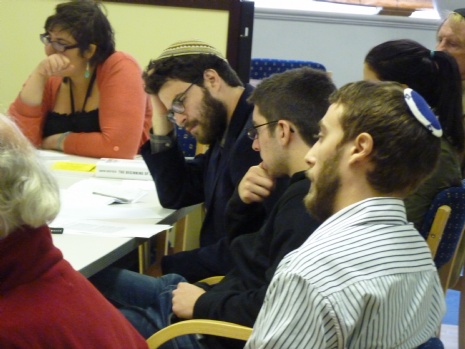 The line up of lecturers included Professor of Ladino at Bar Ilan University, Prof. Ora Schwartzwald, who gave a lecture in honour of her new book Seder Nashim about a 16th century prayer book for women in Ladino by Rabbi Banist; Dr. Naftali Loewenthal, of University College London's Hebrew and Jewish Studies department, on modes of Jewish inclusivism based on the Mishnaic teaching that “every Jew has a portion in the world to come”; Dr. Israel Sandman, Fellow at University College London's Hebrew and Jewish Studies department, on the subject of “Interpreting Scripture as a Spiritual Exercise”; and Rabbi Leibish Heller of Kinloss United Synagogue, who spoke on the Talmud and the problems of the Shylock play from a Talmudic Jewish legal perspective.
The highlight of the full day seminar was a special viewing and guided tour of rare Hebrew manuscripts and early printed works at one of Oxford's oldest colleges, Merton College, est. 1264, located inside what is thought to be the world's oldest library, in Merton College's Mob Quad.
 The viewings included, amongst others, Johann Reuchlin's De rudimentis Hebraicis (1506); Rabeinu Samuel Ben David's Kabbalistic commentary on the Pentateuch, volume one (copied in the 16th century), given to Merton college by Robert Huntington in 1673; the Hebrew Starr document of the grant by Jacob son of Moses of London and his wife Channa to the Scholars of the House of the Scholars of Merton, of a house in Oxford, February 1267. This former Jewish property now forms part of the Front Quad of Merton college.
The talk of Dr. Loewenthal was of particular interest as he sought to explain the theological foundation for the concept of the all welcoming and non-judgemental Chabad House phenomenon that can be found in every corner of the world, as well as Oxford, the Slager Jewish student centre, where the seminar was taking place.
 He explained that since the Enlightenment, Jewish life has been divided between tradition and modernity. For some traditionalists, this led to an exclusivist mode of Judaism. But others argued for inclusivism, despite the differences imposed by secularisation. Models of inclusivism, drawn from Jewish tradition, became important in this struggle.
He argued that the three theological models of Jewish inclusivisim mentioned in traditional Jewish teaching 'Even though he sinned he is a Jew', 'Every Jew has a portion in the World to Come', 'Love your neighbour as yourself', provides the basis for the concept of the Chabad House, established by the late Lubavitcher Rebbe, Rabbi Menachem M. Schnnersohn OBM.
Rabbi Eli Brackman, director of the Oxford University Chabad Society, who organised the seminar, commented that “these popular seminars are an opportunity for people of all levels of knowledge to interact with Jewish teaching and scholarship in a stimulating and open environment, inspiring participants to question and probe Judaism in a serious way”.
Mr. Eliot Shear, who attended the seminar said "the programme was utterly compelling".
The Jewish studies seminar “Yom Limmud” is part of the high profile programme of lectures hosted each year at the Oxford University Chabad Society on a broad variety of subjects.
Over sixty of these lectures can now be viewed at www.oxfordchabad.org/video.