

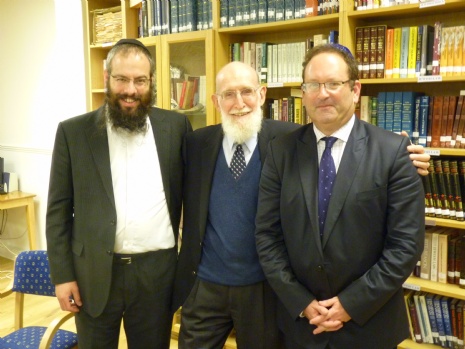
 The Oxford University Chabad Society inaugurated this week a new annual lecture, entitled the “Professor David Sevel Memorial Lecture in Jewish Medical Ethics” dedicated in memory of Oxford Jewish leading ophthalmologist, Professor David Sevel, who passed away in 2006.
The annual lecture has been dedicated by the Sevel family of California and was delivered by renowned expert on Jewish medical ethics, Professor Shimon Glick, former dean of the Ben Gurion University Faculty of Health Sciences., and former head of the Lord Rabbi Immanuel Jakobovits Center for Jewish Medical Ethics at the institution . He also served for over a decade as Ombudsman for Israel's National Health Service.
The lecture entitled “Bioethics: historic roots and current directions” served as a critique on the limits of currently widely accepted principles of medical ethics taught at medical schools around the world that include the four principles of autonomy, beneficence, non-malfeasance and justice. Professor Glick argued forcefully that the foundation of medical ethics as a system cannot be based only on biology or philosophy. The horrors of the Nazi period must serve us as an object lesson. He suggested that the principles must include also the principle of “sanctity of human life”, which has served the medical profession in good stead for centuries.
He pointed out that this additional principle, rooted in Judaic values and the conscience of human history could stem the slippery slide in society towards the alarmingly growing rates of abortions, increase of views supporting infanticide of defective children, neglect of the elderly and increased support for active euthanasia
The memorial lecture was delivered in the presence of Mr. Charl Sevel, son of Professor David Sevel, who introduced the speaker on behalf of the family.
Professor David Sevel, MD, FACS, FRCS, FRCO, was an internationally recognised ophthalmologist and medical researcher whose research had made him a pioneer in modern day ophthalmology. His work in embryonic ophthalmic pathology, treatment of ocular muscle abnormalities, and ocular plastic surgery has helped advance the field of ophthalmology profoundly, and has been recognised by the Royal College of Physicians and Surgeons in England and is reflected by the various prestigious honours and scholarships awarded to him throughout his lifetime.
Ailton wrote...