

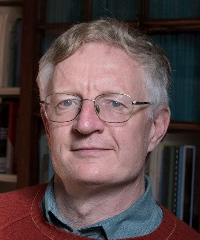
My mother’s mother was an Ashkenazi Jew. To that extent, so am I. I’ll say something about that part of my family – it casts at least a little light on how I became a philosopher.
In my distant ancestry, there were rabbis. One of them tended to a community somewhere in Eastern Europe where the main source of income was smuggling arms across the nearby border. As a result of some treaty, the border moved, so his congregation all had to move too, and he was left without a job.
My great-grandfather was born in Warsaw. He was a feckless character, who wandered around Europe, and self-identified as a philosopher, which conveniently meant that his wife had to do all the work.
He left behind voluminous memoirs, frustratingly so concerned with wallowing in his own sins and hardships that they omit most of what must have been richly colourful experiences.
He had three children, born in Germany, including a son, Nathan, and my grandmother, Malvin, born in the 1890s. They moved to London in 1907, but continued to speak German at home.
My great-grandfather adopted the surname ‘Isaacs’ because it sounded English (to him). He tried to impose some Jewish culture on his children. He describes in his memoir how not even beating Nathan would persuade him to learn Hebrew. My grandmother as a child was too busy riding around London with her friends hanging on to the backs of horse-drawn carts to absorb very much culture from home. In later life, all three children were secular, and assimilated.
The son, Nathan, my great-uncle, was the only member of the family with the skills to keep the family finances afloat. He had to leave school at 16 and find work in a metals trading company. But his real love was for philosophy and psychology.
Nathan joined the army during the First World War, served on the Western Front, was gassed at Passchendaele (one of the grimmest battles in the history of the British Army) in 1917, and was invalided out.
The only story Nathan told about that time concerned his convalescence in the English countryside. He was sitting on a hillside, reading a textbook of psychology, when he found himself being arrested by an army patrol and accused of being a spy. The hillside turned out to overlook an army camp. Worse, he spoke English with a slight German accent, and the book’s illustrations of questions for IQ tests looked to the patrol like plans of military installations. He was marched to the camp, in danger of being shot as a spy. Fortunately, a senior officer was able to recognize that it really was a psychology textbook, and he was released.
After the war, Nathan’s business career prospered. But he did all he could to educate himself in philosophy and psychology.
In 1920 he went to a series of lectures for the Workers’ Educational Association given by Susan Brierley, who had a First Class degree in philosophy from Manchester University, where she had been taught by Professor Samuel Alexander, who was the first practicing Jew to be a fellow of an Oxford or Cambridge college; she had then been trained in psychology at Cambridge.
Nathan bombarded Susie with questions. One thing led to another, and by 1922 she had been divorced by her first husband on grounds of adultery and was married to Nathan (ten years her junior).
As Susan Isaacs, she became perhaps the best-known child psychologist of her generation in Britain. She was also a friend of Melanie Klein, and her ally in the war against Anna Freud and her allies that split the British Psychoanalytic Society in the 1940s (the ‘Controversial Discussions’).
Susie and Nathan together played a leading role in introducing the work of the developmental psychologist Jean Piaget to Britain. Both Klein and Piaget visited the Malting House School, an experimental school in Cambridge in the mid-1920s until its funder went bankrupt. The pupils were mainly bright but troubled children of academics, including the two sons of the philosopher G.E. Moore. The Malting House School inspired a similar but even more chaotic school founded by Bertrand Russell a few years later.
Nathan was serious enough about philosophy to present a series of papers to the Aristotelian Society and publish them in its Proceedings. He also published a book, The Foundations of Common Sense: A Psychological Preface to the Problems of Knowledge (1949). His main theme was that epistemologists and philosophers of mind needed to take more account of what psychologists were discovering. He was surely right about that, and ahead of his time, but he didn’t have the academic training to put his point across really effectively.
In the 1920s Malvin, my grandmother, worked as a typist for a Zionist organization in London, for the money rather than the ideology. Like me, she was a two-fingered typist, so she had to type frenetically to keep up with the touch typists. She married a naval officer (my grandfather). They quickly separated, but my mother Karina was either the cause or the effect of the marriage (it’s not clear which). Malvin was a chaotic single parent who had to work for a living. She was also a political activist, involved in the left-wing Independent Labour Party. Later, when I knew her, the two causes she was mainly involved in were Anti-Apartheid (against the white regime in South Africa) and CND, the Campaign for Nuclear Disarmament.
It was clear to Nathan that Malvin was not able to bring up a child by herself. Fortunately, he was in a position to pay for my mother to go to private boarding schools, (Caldecott House and Frensham Heights, not Jewish ones). She started at the age of three. This enabled her parents to keep up a pretence of a working marriage, aided by the fact that as a naval officer Karina’s father Eric was away for much of the time in the Far East (especially during the Second World War).
Later, my mother, as a teenager, discovered that it was all a façade, and that when in England Eric was living with another woman. My mother made her parents’ divorce so the situation could be regularized. She has always liked tidiness.
Malvin and Nathan’s father died before my mother was born. Jewish culture played virtually no role in her upbringing. With an understandable desire to fit in, she had herself confirmed as an Anglican.
I owe my life to my mother’s preference for dark blue over light blue. On those grounds alone, she supported Oxford over Cambridge in the Boat Race, a big event in London. When it came to applying for university, her allegiance was already decided. She applied to Oxford, got in, and met my father here.
Later, both my parents taught English Literature at Oxford, she as a Fellow of St Hilda’s, he as a Fellow of Jesus College.
My mother once threatened to write an autobiography entitled I Married a Goy, but in truth her Jewishness did not mean much to her.
She and my father did become disillusioned with Anglicanism — we lived in a village outside Oxford where Anglicanism was a form of social climbing rather than spirituality — but then they became Quakers instead. I was brought up in an atmosphere of lukewarm and ill-defined Christianity.
I found Jesus rather wet. Meekness has never been one of my values. Athene, the goddess of wisdom and patron of Odysseus, the most cunning of the Greek heroes, struck me as far worthier of worship, if one had to worship someone.
There was nothing particularly Jewish about my upbringing. Indeed, I didn’t know that I was Jewish until the age of eleven, when my mother took me to the Royal Festival Hall to see an exhibition about the excavations at Masada, and with apparent casualness mentioned it as we went round. The surname ‘Isaacs’ should have been a giveaway, but I didn’t know that it was Jewish.
I have always liked to find ways of not belonging to my surroundings. Being Jewish was another way of not belonging, and as such I welcomed it.
I still have faint memories of sitting talking with Nathan on a hillside, near his house in Sussex, as a very small boy, though none of what we said. Much later, my parents told me that they had been following behind, and heard our voices coming from amongst the daffodils, discussing philosophy.
Nathan liked to provoke children to think; I remember my younger sister’s indignation when he began a story with ‘When I was a little girl’. So perhaps that conversation amongst the daffodils was an initial spark. If so, it was a long-smouldering one, since for many years my ambition was to be an archaeologist.
It would be more impressive if I could say that I grew up in a family where no one had ever heard of philosophy, or at least one where everyone despised it. But, in my family, philosophy was highly respected. Both my parents regarded it as intellectually much more serious than their own subject, English Literature.
Lecture delivered at Friday night Shabbat dinner at the Oxford University Chabad Society - Hilary term, 2026