

Rabbi Adin Steinsaltz Visits Oxford to Debate Contemporary Western Society
 Renowned speaker and thinker Rabbi Adin Steinsaltz visited Oxford's Chabad Society this week to deliver a lecture in honour of Sir Isaiah Berlin, considered by many to be one of the most prominent liberal thinkers of the twentieth century.
Not just content with simply presenting a lecture, the indefatigable Israeli rabbi and a group of students toured Jewish sites of interest in the world-famous university city, including the location where it is thought that Haggai of Oxford - a 13th century convert to Judaism - was executed by edict of the Church. There they prayed the afternoon mincha service with the traditional mourner’s kaddish prayer.
Rabbi Steinsaltz also visited the university’s Bodleian Library which is usually closed to most members of the general public. The library houses over 11 million volumes including many important Jewish manuscripts, such as the oldest manuscript of Maimonides’ classic work on Jewish law, the Mishne Torah, signed by the author.
 The lecture itself was attended by approximately 90 students, academics and community members in the Oxford Chabad Society’s David Slager Jewish Centre.
Rabbi Steinsaltz - who had at one time a correspondence with Berlin - explained that the late philosopher was of distinguished Jewish lineage being a direct descendent of the Rabbi Schneur Zalman of Liadi, founder of the Chabad Chassidic dynasty.
Speaking about how he admired Berlin for his “clarity of mind and expression,” he described how he was “perhaps one of the last intellectuals in England.”
“I’m not saying that after Berlin there ceased to be a professional intelligentsia,” he reassured the largely academic audience with his trademark laugh and smile.
“An intellectual is a person with boundless curiosity. He doesn’t have to be a professor in a university; he could be a shoemaker.”
He used his lecture to mount a critique of contemporary western culture which, with the proliferation of technology and onset of globalisation, has come to dominate life throughout the world, even in places like Japan, China and Israel that are not strictly considered ‘western.’
With the decline of faith and religion, in particular Christianity in the West, he described how the resulting void has been filled by the pagan gods of the past, albeit in different guises.
For Steinsaltz, western society’s lust for money and power is the modern-day Baal, while 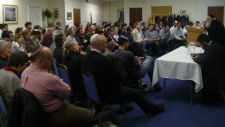 banks and trading houses are the temples in which the ancient god is worshiped.
So then, where does Judaism stand?
Steinsaltz believes that Jewish culture is “progressive” and opposes this new form of paganism.
“Jews have embraced progress and innovation from very early on in their history,” he explained. “It is central to our belief that humanity was created as partnership with G-d in creation to make things better.”
From this point of view, he believes that “we’re standing in the same place as our father Abraham” who rejected the idols and culture of his own surroundings.
He concluded by mentioning a disagreement between two 18th century European intellectuals.
“Leibniz said that our world is the best of all possible worlds. Voltaire, being his contemporary, thought the opposite, that this is the worst of all possible worlds. I say that this is the worst possible world, but there is still hope!"
Many would consider Oxford University to be at the forefront of contemporary Western society and, as such, his critique met with mixed reactions.
“He’s a timeless and reassuring Jewish archetype,” said Erica Steinhaur, a local Oxford resident and alumna of the University. “He clarified a lot of very pressing issues relevant to the world in which we live.”
However, one attendee disagreed.
“I didn’t agree with a lot of what he said, though I think his mode of presentation was very engaging and it is good to give a platform to debate and challenge the prevailing status quo.”
Rabbi Eli Brackman, executive director of Oxford University Chabad Society, anticipates this lecture will serve as the basis for a regular annual lecture dedicated to Jewish philosophy.
“We want to dedicate a series of lectures in celebration of Jewish life and history in Oxford,” explained Brackman. “It isn’t about Berlin’s philosophy per se; rather, it marks the fact that Berlin was and is still is a figurehead for Jewish intellectual life in Oxford.”
To see a photo gallery from Rabbi Steinsaltz's trip to Oxford, click here.