

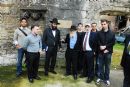
 The Oxford University Chabad Society organised one of the first formal pilgrimages in a few centuries to the site of Osney Abbey, where Robert of Reading, who changed his name to Haggai of Oxford, was burnt alive for his Jewish faith in 1222AD.
Osney Abbey, later Osney Cathedral, was founded after the Norman Conquest and originated as a house of Augustinian canons at Osney, west of
The most significant event in the history of the abbey came in April 1222 when a provincial council met there, charged with applying the Lateran decrees in
It seems that it was at that council meeting when it was decided the fate of Haggai of Oxford that he shall face burning at the stake for not abandoning his newly found faith to Judaism. He had also found a Jewish woman whom he married in the medieval Jewish community in
Upon responding negatively to the ultimatum of the council, that he would rather die than give up his faith, on 4th Iyar, 27 April, 1220, he was burnt alive at the stake at the entrance to Osney Abbey.
The ruin of a rear section of the Abbey is still standing and is owned by a private family since 1910, as part of the site of the Oxford Marina. A private property, it is not open to the public and accessible only by appointment.
The knowledge of the Jewish history of the site is obscured, not just by the fact that it has been sold to private owners and is fenced up without public access, but the plaque placed in 1931 indeed mentions the episode but merely states he “surrendered his life for his faith”, without any mention of his Jewish identity as being the sole reason for his death.
The remains of the Abbey used to be a site of annual pilgrimage for the Jewish community in the 19th century, most likely on or near the date of his death. Another site of pilgrimage was the site of the medieval Jewish cemetery that was visited every Friday afternoon by members of the Jewish community, which since 1641 was turned into the Oxford University Botanic gardens. With this site too, there is no visible mention of this Jewish historic site other than an obscure plaque hidden behind the Danby gate. The website of the Botanic gardens does not even honour it a mention.
Rabbi Eli Brackman, director of Oxford University Chabad Society, came up with the idea of renewing this 19th century custom of pilgrimage to the site of Osney Abbey during a tour he gave of medieval
The pilgrimage took place in the same month of the death of Haggai of Oxford, last Tues, in the Hebrew month of Iyar and included an address by Rabbi Eli Brackman, accompanied with visiting Rabbi Adin Steinsaltz, and a Mincha prayer service, led by Rabbi Brackman, with the traditional mourners kaddish.
It is with hope that this renewed pilgrimage tradition will help promote greater interest and knowledge of the importance of Jewish history in this historic city of
Naomi Lerner Rosenberg wrote...
This is, indeed, interesting. We heard nothing of this individual when we were in Oxford though we made it a point to review the Jewish history and visit all the Jewish sights in Oxford. One comment/question: would it not be more appropriate to use the initials CE (Common Era) or BCE (Before the Common Era) to denote secular dates rather than AD (Anno Domini - The Year of Our Lord), certainly in reference to a man who who was burnt alive for his Jewish faith, but even in other broader contexts. As a Jew and an Israeli that AD really strikes a discordant note.
Best to you, Freidy and your wonderful children,
Naomi Lerner Rosenberg - Jerusalem