

ב"ה
Chabad at Oxford
Lectures at the Oxford University Chabad Society
717 items in this section

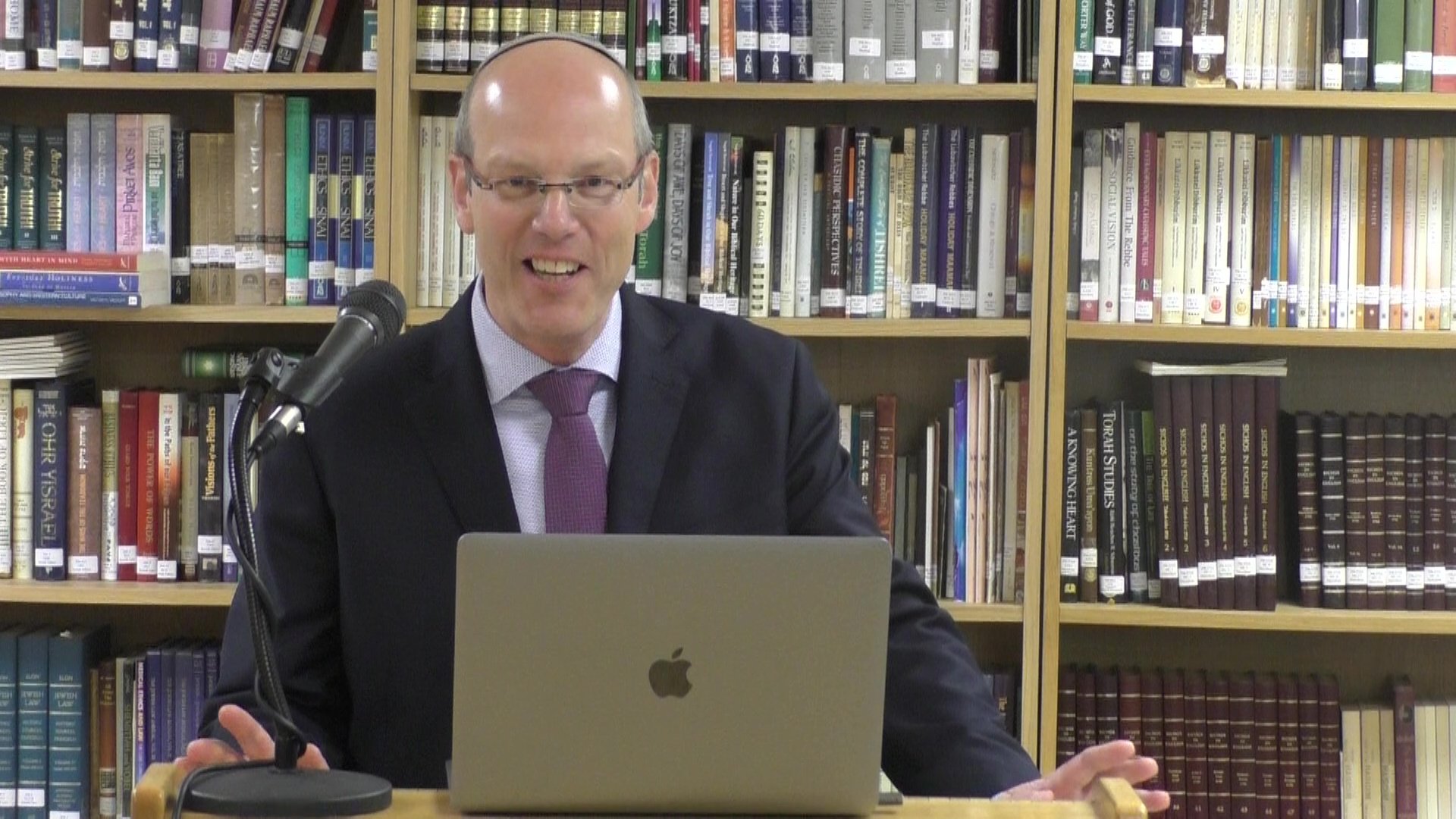
Rabbi Steinberg presents an extensive overview of the ethical and halachic considerations with regards to euthanasia and physician assisted suicide. He concludes with the proposal to differentiate between allowing the withholding of treatment for terminally ill patients, and actively euthanizing or assisting the patient to commit suicide.




How Jewish Law facilitates freedom.
Kim Treiger-Bar-Am is a legal academic in Israel. Her education began at Yale University in philosophy and law, with masters and doctoral studies in law at the University of Oxford. Treiger-Bar-Am has recently published “Freedom and Respect in Jewish Thought”. It relies upon intuitions gathered from conversations with many people, as well as philosophical and legal works. Her previous book, “Positive Freedom and the Law”, examines Kantian theory and Jewish thought.


Lena Zlock is the Principal Investigator of the Voltaire Library Project and inaugural visiting researcher at the Voltaire Foundation’s Voltaire Lab at the University of Oxford. She currently also studies at Stanford University, double-majoring in History and French. Her research is supported by a Chappell Lougee Scholarship, a Major Grant, and a Conference Grant from the Vice Provost for Undergraduate Education at Stanford University. She is a recipient of the Oxford University Press Prize.

Joshua Getzler is Professor of Law and Legal History at the University of Oxford and a Fellow of St Hugh's College, Oxford. He completed his first degrees in law and history at the Australian National University in Canberra, and his doctorate in Oxford, as a member of Balliol and Nuffield Colleges. He serves on the editorial board of the Oxford Journal of Legal Studies and the Journal of Equity and is co-editor of the new OUP monograph series Oxford Legal History.


Randol Schoenberg is a leading US lawyer specializing in cases involving looted Nazi art and the recovery of property stolen by the Nazi authorities during the Holocaust. During the past decades, he has litigated several prominent cases, including the Republic of Austria v. Altmann case, in which he sought the return of six famous Klimt paintings to his client, Maria Altmann.

This lecture tells the story of Oxford resident Vivien Sieber's grandmother, Paula Sieber, who was a cinema owner in Vienna before becoming a refugee in 1938. She became the second matron in a hostel for girls saved by the Kindertransport. Her father, Peter, was interned. Kino and Kinder has many quotes from the girls themselves (as adults) on their experience of leaving their parents, their journey to England and arriving at the hostel. The girls describe adjusting to hostel life. Much of this history is told using contemporaneous writings – journals, letters, archive documents along with adult reflections on their experiences of the girls cared for in the hostels.


Memory of wrongs and suffering and the paths to reconciliation.
Vaira Vīķe-Freiberga served as the sixth President of Latvia. Dr. Vike-Freiberga was born in 1937 in Riga, Latvia. In order to escape the Soviet occupation, her family fled the country in 1945 and became refugees. After arriving in Canada in 1954, she entered the University of Toronto, obtaining a B.A. (1958) and an M.A. (1960) in Psychology. Resuming her education at McGill University in Montreal, she earned a doctorate in experimental psychology in 1965. She is the author of seven books and about 160 articles, essays or book chapters. Vaira Vīķe-Freiberga is a Founding Member of the Club de Madrid and has been a Member of the Global Leadership Foundation since 2010.

Ruth Bourne was born in Manchester in 1926. At the age of 18, she was sent to a training camp in Scotland, and thence to join the chain of codebreakers in Bletchley Park to train to operate the Turing machine invented by Alan Turing to speed up the breaking of the Enigma encoding machine, recently the subject of the film “Imitation Game”. In 1994 she returned to Bletchley Park as a volunteer tour guide and demonstrator of the Turing Bombe for 22 years and two further years as a demonstrator in the Museum of Computing, retiring at the age of 92.


Walter Bodmer, former Principal of Hertford College, Oxford, fled Nazi Germany in 1938 as a young child, and is a world-leading geneticist. He was one of the first to suggest the idea of the human genome project. Early in his career, Walter helped to discover the human leukocyte antigen (HLA) system, vital for the success of organ and bone marrow transplants. He was the first Director General of the Imperial Cancer Research Fund and was knighted in 1986. He is currently Head of the Cancer and Immunogenetics Laboratory, Cancer and Immunogenetics Laboratory, Department of Oncology, University of Oxford.


A look at the unfortunate children left behind from the Kindertransport to Britain in 1938-9. What was the process for selection?
Paul Weindling is Professor of the History of Medicine at Oxford Brookes University and formally part of the Wellcome Unit for the History of Medicine at the University of Oxford.


How my family saved a Dutch Jewish girl from the holocaust.
Bart van Es is a Professor of English Literature at the University of Oxford and a Fellow of St Catherine's College. He is most recently the author of 'The Cut Out Girl: A story of War and Family, Lost and Found (Fig Tree),' which follows the story of a Dutch Jewish girl who was taken in by the author's grandparents before her own parents were sent to Auschwitz.

Manfred Deselaers, born in Duesseldorf, Germany, is a theologian who lives in Auschwitz, dedicating his life to German-Polish Reconciliation and Christian-Jewish Dialogue in Auschwitz. He studied theology in Tuebingen (1976-1981) and Chicago (1978-1979), served as curate in Moenchengladbach and Board member of the Society for Christian-Jewish Cooperation.


Elie Wiesel's Traumatic Memoir
Jason O'Connor is a PhD student at Florida Atlantic University. He has a BA in Judaic Studies and Political Science from Florida Atlantic University, an MA in Near East and Judaic Studies from Brandeis University and an MA in Holocaust and Genocide Studies from Gratz College. His interests include post-Holocaust memory and commemoration in Eastern Europe and Post-Communist Polish Jewish relations.


The case for child refugees
Alf Dubs was born in Prague, arriving in the UK in 1939 on a Kinderstansport train at the age of six. He was an elected Member of Parliament from 1979-87. After losing his parliamentary seat, he became CEO of the Refugee Council. In 1994 he was appointed to the House of Lords as a Labour Peer. In May 1997, he became a Minister for Northern Ireland until December 1999. He is currently on the EU External Affairs Sub-Committee which is looking at aspects of trade post Brexit. He is also a member of the British Irish Parliamentary Assembly and of the Parliamentary Assembly.

Anita Lasker-Wallfisch was deported to Auschwitz in December 1943. Due to her being an accomplished cellist she was saved and was made to join the Women's Orchestra. She was forced to play marches as the slave laborers left the camp for each day's work and gave concerts for the SS. In October 1944, with the Red Army closing in, Anita was taken to Bergen-Belsen where she stayed until its liberation by the British.


John Izbicki
On the evening following his eighth birthday the terrors of Kristallnacht changed John Izbicki's life forever. Here he recounts the story of his escape from Germany and his arrival in Britain.
John Izbicki was born to a Jewish family in Berlin, after escaping Germany he went on to lead a successful career as a British journalist. His memoir, Life Between the Lines, was published in 2012.


Rabbi Moshe Genuth, is currently a senior lecturer at HaRav Ginsburgh's school of Jewish psychology, Torat HaNefesh. He has been secretary to Rav Ginsburgh for the past 30 years, and edits many of his publications in both Hebrew and English including the weekly magazine Wonders, an English collection of HaRav Ginsburgh's teachings. Rabbi Guneth is a graduate of the Johns Hopkins University in Engineering and received his rabbinic ordination from HaRav Zalman Nechmiah Goldberg. He founded a boys' talmud torah and a girls' elementary school in Jerusalem.

Oftentimes, taking on more religious actions and worrying about reward and punishment fill the contemporary Jewish rhetoric. But there are fundamentals that run deeper and embolden our unique personal value, self-development, and loving bond with G-d. In this talk, we will explore some fundamental Jewish ideas upon which all of Judaism is built.


Anti-Semitic comments of Helen Thomas, the so-called “dean” of the White House press corp, were exposed in a brief video encounter with Jewish filmmaker David Nesenoff. The video went viral and thrust Thomas’ bias into the spotlight, forcing her career to end. Here Nesenoff tells his fascinating story (with much humor), and makes a passionate plea for Jews to combat anti-semitism by “doing Jewish” in their own lives.


Professor Ratzon tells the story of the discovery of the dead sea scrolls, the key figures involved, and the main contents of the scrolls.
Eshbal Ratzon is an Associate Professor at the Department of Jewish Philosophy and the Cohn Institute for the History and Philosophy of Science and Ideas at Tel Aviv University. She specializes in Jewish Studies, with a focus on Second Temple literature and the Dead Sea Scrolls. Her research examines ancient science, especially calendars and astronomy, combining historical and philological approaches with Digital Humanities methods.


David Selis describes the history and culture of the Samaritans, focusing on their celebration of Passover. Specifically, it focuses on Passover 1968 the first time they were able to bring the Passover Sacrifice on their Holv Mountain, Mt. Gerizim, as a united community having been previously separated by pre-67 borders. David will draw on the recently discovered field notes and never before seen photographs from the archive of Prof Johanna Spector, a major scholar of Samaritan music and culture who was present for the Passover 1968 celebration.


Professor Don Seeman received his Ph.D. in Anthropology from Harvard University and is Associate Professor in the Department of Religion and the Tam Institute for Jewish Studies at Emory University. He has taught at the Hebrew University of Jerusalem and in the Department of Social Medicine at Harvard Medical School.

Alec Nacamuli was born in Alexandria and fled after the Suez crisis in 1956. He is a council member of the Nebi Daniel International Association which strives to protect the Jewish heritage in Egypt and chairman of Sephardi Voices UK, an oral history project recording the lives of Jews from Arab countries who resettled in the UK. He is also a volunteer guide on Ancient Egypt at the British Museum.


Oded Borowski taught biblical archaeology and Hebrew at Emory University for 41 years. Born in Palestine under the British Mandate, he was a member of Kibbutz Lahav, in the northeastern Negev. He received his MA/PHD in Near Eastern Studies from the University of Michigan in Ann Arbor. His dissertation, which became his first book, deals with agriculture during the Iron Age in Israel.


Christophe Stener graduated from Institut d'Etudes Politiques de Paris and Ecole Nationale d'Administration. He is a fellow at the Université Catholique de l'Ouest (France) and author of 'The Book of Esther: An Exegesis in Pictures' and 'Dreyfus, le Judas français: Iconographie antisémite de l'Affaire.'


Lord Neuberger discusses why Jews get into law, recounts his ups and downs on the way to the UK Supreme Court, and reveals his life advice.
David Edmond Neuberger, Lord Neuberger of Abbotsbury was appointed President of the Supreme Court in 2012, the second person to hold that office since 2009 when the Court replaced the Appellate Committee of the House of Lords. He previously held the post of Master of the Rolls from 2009. Lord Neuberger was educated at Westminster School, later studying Chemistry at Christ Church, Oxford.


The Isaac Meyers memorial lecture
Kerstin Hoge is the Yiddish Lector at the Oxford Centre for Hebrew and Jewish Studies and was appointed as University Lecturer in German Linguistics in 2008. She teaches German and General Linguistics to students across the university. Her current work focuses on the cross-linguistic properties of causal interrogatives. She is the review editor of the Journal of Linguistics.

Official Fellow and Tutor in English, Fellow for Libraries and Keeper of the Archives, St John’s College, University of Oxford. His first two books focused on modern fiction, and considered questions about literary value in contrasting ways. The first, J.M. Coetzee and the Novel (2010), Philip Roth: Fiction and Power (2014). His recent work is Beyond the Ancient Quarrel (2018)—a collection of essays by a range of contemporary philosophers and literary critics.

Stephen Fry is an English actor, with Jewish heritage, screenwriter, author, playwright, journalist, poet, comedian, television presenter, film director and all-round national treasure. Fry has written and presented several documentary series, contributed columns and articles for newspapers and magazines, appears frequently on radio, reads for voice-overs and has written four novels and three volumes of autobiography, Moab Is My Washpot, The Fry Chronicles and his latest, More Fool Me.

Stay Strong, Keep Calm, Hold True
Jonathan Sacerdoti is a journalist and commentator with a broad focus on global affairs, culture, and society. With over 15 years of experience reporting on Israel and the Middle East, he has covered wars, politics, and culture, including as the UK correspondent for Israeli TV channel i24news. He is a regular commentator on international news channels, and has contributed to a wide range of outlets, including Fox News, BBC, Sky News, Talk TV, Channel 4, i24news, Daily Telegraph, Daily Mail, Daily Express, The Spectator, and the Jewish Chronicle. As the son of a Holocaust survivor, Jonathan is passionate about tackling antisemitism and racism.

Daniel Johnson attended state schools and Magdalen College, Oxford, graduating with a First in Modern History in 1978. As a foreign correspondent for the Daily Telegraph, covering Germany and Eastern Europe, and is an acknowledged expert on German history and culture. At The Times he was Literary Editor and Comment Editor, then Associate Editor of the Telegraph. He is now Editor and co-founder of the online platform The Article, for which he has written some 800 leading articles in the past three years. He is the author of White King and Red Queen: How the Cold War was fought on the Chessboard (2007).


'Isaac Meyers Memorial Lecture'
Daniel Johnson attended state schools and Magdalen College, Oxford, graduating with a First in Modern History in 1978. As a foreign correspondent for the Daily Telegraph, covering Germany and Eastern Europe, he participated in the fall of the Berlin Wall and is an acknowledged expert on German history and culture. At The Times he was Literary Editor and Comment Editor, then Associate Editor of the Telegraph. He is now Editor and co-founder of the online platform The Article. He is the author of White King and Red Queen: How the Cold War was fought on the Chessboard (2007).

James Connelly is an Emeritus Professor of Political Theory at the University of Hull. After taking his PhD at the University of Southampton and several years running a secondhand book shop he taught at Southampton Solent University until 2006. He then moved to the University of Hull where he taught political theory, electoral systems, and environmental politics. His research focuses on environmental politics and ethics, and the philosophy of the British Idealists.

Shalom Sabar is Professor of Jewish Art and Folklore at the Hebrew University of Jerusalem. Among his books are: Ketubbah: Jewish Marriage Contracts of the Hebrew Union College Skirball Museum and Klau Library (1990); Mazal Tov: Illuminated Jewish Marriage Contracts from the Israel Museum Collection, Jerusalem (1994); Jerusalem - Stone and Spirit: 3000 Years of History and Art (with Dan Bahat; 1997); The Life Cycle [of the Jews in the Lands of Islam; 2006].

How the Nuremberg trials set legal present for prosecuting crimes against humanity.
James Friedberg is Posten Professor of Law, West Virginia University. He received a J.D. from Harvard in 1975 and a Diplôme in International Human Rights from Strasbourg in 1989. He founded and directed the West Virginia University College of Law Immigration Law Clinic for fifteen years.

Jamie Metzl is a technology and healthcare futurist, geopolitical expert, novelist, social entrepreneur, media commentator, Senior Fellow of the Atlantic Council, Singularity University faculty member, and the Founder and Chair of the global social movement OneShared.World. In 2019, he was appointed to the World Health Organization expert advisory committee on human genome editing.


Professor Karen Lang has taught at the California Institute of Technology, the University of Southern California and the University of Warwick. The editor of The Art Bulletin during the journal's centenary year, she has been a Leverhulme major research fellow, a Paul Mellon fellow at the Center for Advanced Study in the Visual Arts at the National Gallery of Art, Washington DC, a Getty scholar, Rudolph Arnheim Visiting Professor at the Humboldt University Berlin, and Leverhulme Visiting Professor at the University of Warwick.

Roger Griffin is widely acknowledged to be one of the world's foremost experts on the socio-historical and ideological dynamics of fascism, as well as the relationship to the modernity of violence stemming from various forms of political or religious fanaticism, and in particular contemporary terrorism. In particular, his theory of fascism as a revolutionary form of ultranationalism driven by ‘palingenetic’ myth has had a major impact on comparative fascist studies since the mid-1990s. In May 2011 he received an Honorary Doctorate from the University of Leuven in May 2011 in recognition of his services to the comparative study of fascism.

Ritchie Robertson is Taylor Professor of the German Language and Literature, Fellow of The Queen’s College, University of Oxford. He is interested in a wide range of authors and topics in the period from 1750 onwards, notably Kafka; Heine; Schiller; Austrian literature; and the Enlightenment as an international movement.

Peter Hacker is the leading Wittgenstein scholar at Oxford. He studied philosophy, politics, and economics at The Queen's College, Oxford from 1960–63. In 1963–65 he was senior Scholar at St Antony's College, Oxford, where he began graduate work under the supervision of Professor H. L. A. Hart. His D.Phil thesis "Rules and Duties" was completed in 1966 during a Junior Research Fellowship at Balliol College, Oxford. Since 1966 Peter Hacker has been a fellow of St John's College, Oxford, and a member of the Oxford University philosophy faculty. Hacker is Emeritus Research Fellow of St John's College, Oxford, and is presently Professor of Philosophy at the University of Kent.


Adele Berlin is Professor Emerita of Biblical Studies at the University of Maryland. She is co-editor of The Jewish Study Bible, with Marc Zvi Brettler. She has written several commentaries of her own, including one on the book of Esther, published in English by the Jewish Publication Society and in Hebrew in the Miqra le-yisrael series.

Piergabriele Mancuso received his doctoral degree in Jewish Studies from University College London, 2009. He was a fellow at the Oxford Centre for Hebrew and Jewish Studies as a Phd student fellow and at the Warburg Institute, London. In 2001 he received a degree in music at the music academy in Adria, Venice and since 1999 he has been an active member of Laboratorio Novamusica, a contemporary music ensemble based in Venice. His research interests include early medieval southern Italian Judaism, Jewish astronomical and astrological tradition, Hebrew and Latin paleography, Jewish music and ethnomusicology, 17th-19th century Italian Jewry, as well as Venetian and Florentine history.


The anthropic cosmological principle and the multiverse hypothesis
Dr. Shaun Henson teaches and researches at Oxford University’s Faculty of Theology and Religion. He works at the intersections of science, philosophy, and religion, teaching in areas like science and religion. Shaun has recently collaborated on an international research project based at the London School of Economics investigating G-d’s Order, Man’s Order, and the Order of Nature.


Dirk van Miert is assistant professor of Early Modern Cultural History at the Faculty of Humanities, Utrecht University. He is editor-in-chief of Lias - Journal of Early Modern Intellectual Culture and Its Sources, and chair of the Dutch-Belgian Society for the History of Science and Universities. His latest book is entitled The Emancipation of Biblical Philology in the Dutch Republic, 1590-1670 (Oxford: OUP, 2018).

Professor John Broome is Emeritus White's Professor of Moral Philosophy at the University of Oxford and Honorary Professor at the Australian National University. He works on normativity, rationality and reasoning, and also on the ethics of climate change. He was Lead Author of the Fifth Assessment Report of the Intergovernmental Panel on Climate Change. He is author of Rationality Through Reasoning, Climate Matters: Ethics in a Warming World, Counting the Cost of Global Warming, among other works.


A detailed analysis of the Torah status of the Patriarchs and the 12 Tribes. Were they merely in the category of Noahides with extra personal commitments or did they actually convert to be Jewish? Examining many pre-Sinai narratives, as well as the commentary of Rashi, as recorded in the manuscripts, sheds light on this query.


The Torah portion begins with Jacob’s return to his father’s home, “And Jacob dwelt in the land of his father's sojourning…These are the generations of Jacob… Following a brief overview of the different interpretations in the commentaries on this verse, we focus on Rashi’s commentary, which explains with a parable of a pearl lost in the sand. When examining nuances in the manuscript, we can attempt to better understand the precise details employed in the parable.


